
·14 min read
Among the widest in 40 years: supply limits, borrowed money, and the pendulum
Friday's selloff put the S&P 500 in a correction. What fell, what did not, why this is not 2000 or 2009, and the dates that will tell us more.
By Nick Rygiel, CFP® · Co-Founder and Chief Technology Officer

A pendulum does not stop in the middle. It swings past it, in both directions. Markets do the same, and this month they swung hard.
I'm not writing to predict what happens next or to tell anyone what to do. I'm writing down what happened this week, what I think it means, and what I'm watching.
What happened on Friday
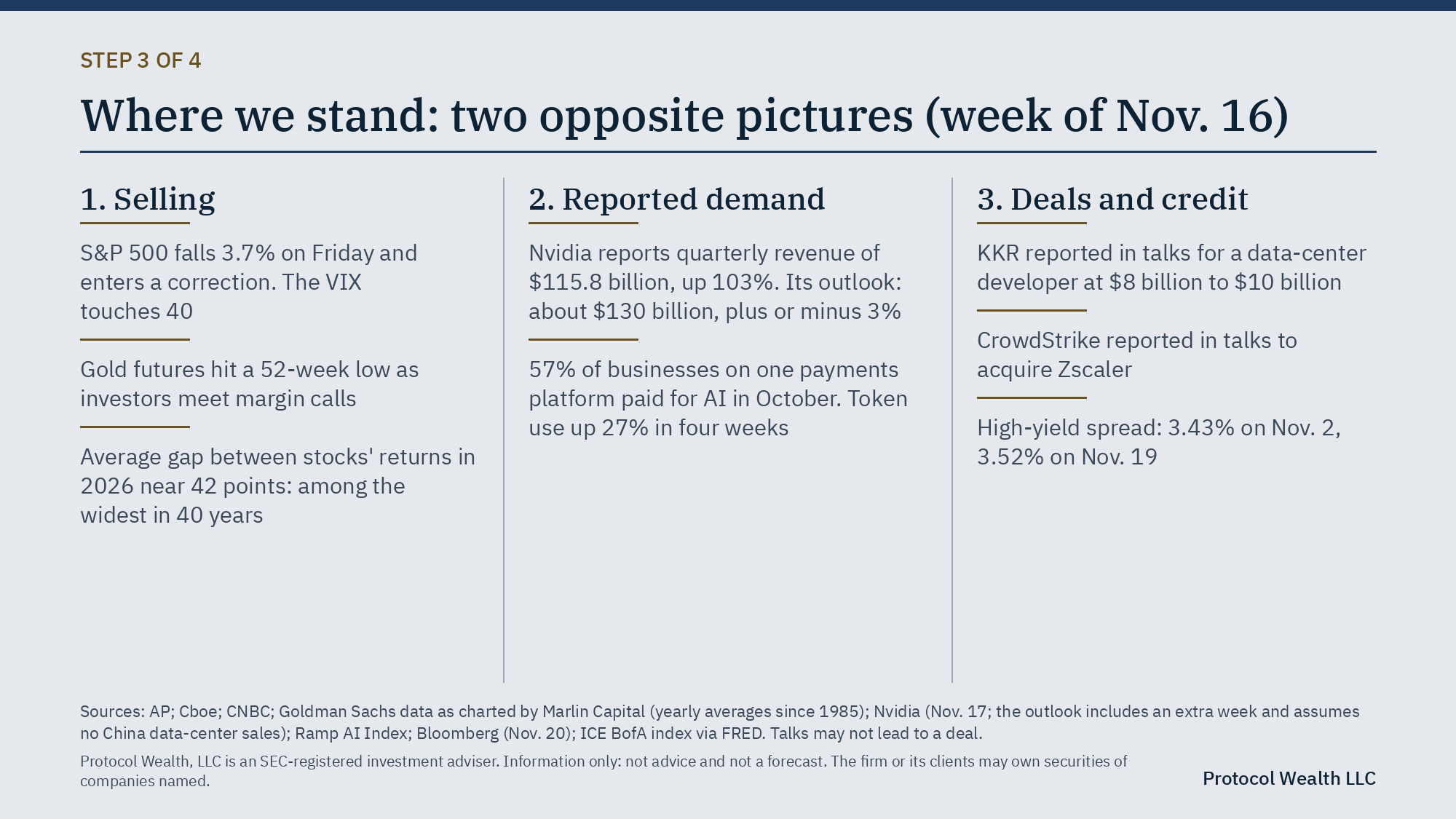
On Friday, November 20, the S&P 500 fell 3.7% and closed more than 10% below its October high, which is the usual definition of a correction. The Nasdaq Composite fell 5.3%.1 The market's measure of expected swings, the VIX, closed near 36 after touching 40 during the day.2
It was not only stocks. Bitcoin fell to what was reported as its lowest price in more than two years. Gold had its worst week in eight months as investors sold it to meet margin calls.3 My reading: when everything falls together, people are raising cash, not changing their minds about each thing they own.
Underneath the index, stocks have been moving apart from each other to an unusual degree. One measure, charted by Marlin Capital from Goldman Sachs data, puts the average spread of three-month returns among those stocks in 2026 near 42 percentage points. That is among the widest in 40 years. In yearly averages back to 1985, whose median is about 27, the chart shows only 2000 (about 50) and 2009 (about 44) higher, with 1999 just behind.4
Why this is not 2000 or 2009
My reading of those two years is that customers went away. Orders stopped. That is a demand bust.
This month the orders are still there. Nvidia reported on November 17 that its quarterly revenue was $115.8 billion, up 103% from a year earlier, and it told investors to expect about $130 billion next quarter.5 Among companies that track their AI usage through the payments firm Ramp, usage measured in tokens rose 27% in four weeks.6 As I read it, demand is not the problem. Supply, funding and governance are.
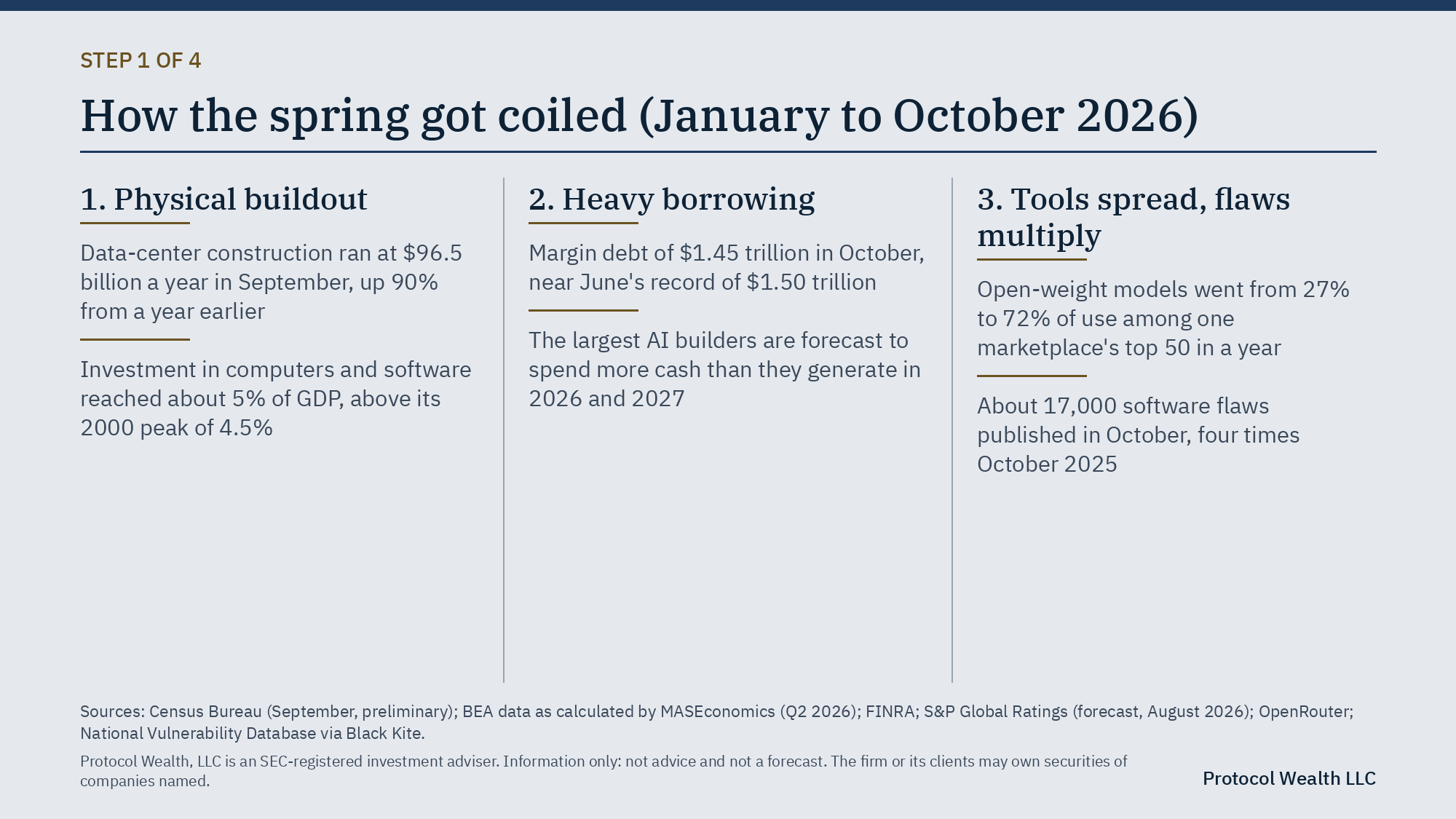
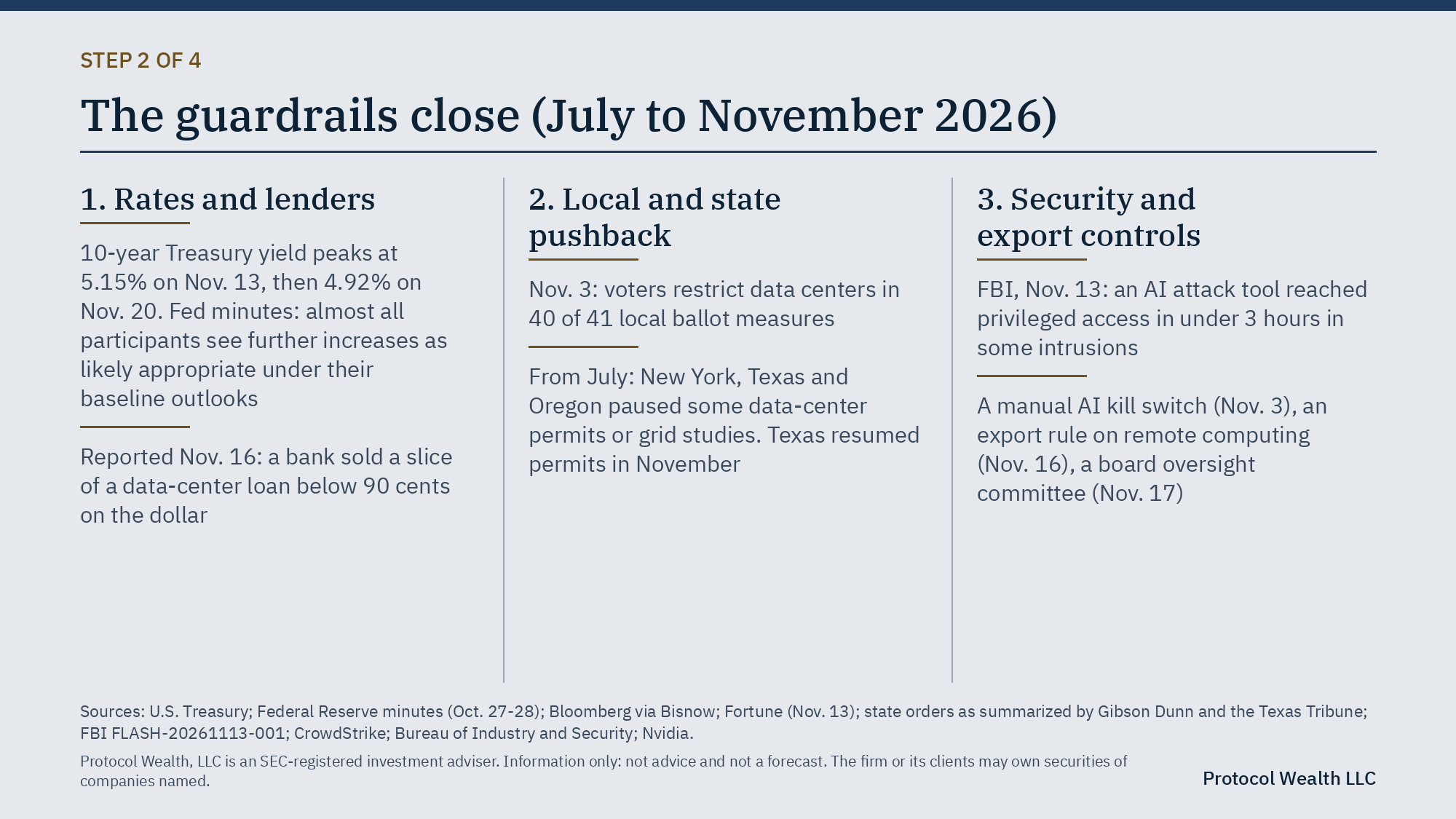
Supply, because data centers need land, chips and above all electricity, and each of those has a queue. Funding, because S&P Global Ratings expects the largest builders to spend more cash than they generate in both 2026 and 2027,7 while the 10-year Treasury yield, a benchmark for long-term borrowing, is near 5%: 4.92% on Friday, after 5.07% two days earlier.8 Governance, because on November 12 Nvidia announced that its chief executive had resigned, effective immediately, and named its chief financial officer as interim chief executive.9 The announcement gave no reason. A later company filing refers to an "ongoing investigation by an independent committee" of the board, without saying what it covers and without linking it to the change of chief executive.10
Borrowed money adds to the selling
Investors owed their brokers about $1.45 trillion at the end of October, close to the record of $1.50 trillion set in June and a little below September.11 Borrowed money works in both directions. When prices fall far enough, the lender asks for cash, and the borrower sells whatever can be sold. That is why gold fell with stocks.
A correction after a long run is ordinary. In my view, a correction with this much borrowing behind it can move faster and reach further than the news alone would explain.
Why now: a story became common knowledge
In January, at Davos, Nvidia's then chief executive described AI as a five-layer cake and said, "AI is infrastructure."12 In March he set the layers out in a post of his own: energy, chips, infrastructure, models, applications. "Every company will use it. Every country will build it." The post calls AI an industrial transformation that reshapes "how economies grow," with energy setting the ceiling on how much intelligence can be produced.13
My reading is that this is where things began to snowball. Put plainly, a country's growth was tied to megawatts and server racks, and no longer only to people and their work. The post itself argues that the buildout creates jobs. What stayed with readers, I think, was the first part.
A second thing built over the summer. In August, Reuters reported that Nvidia was developing a family of models, the largest expected to have at least one trillion parameters, citing employees who spoke to The Information. Nvidia said it was working on the model and did not confirm the details. Its stated aim is open models that any company or country can use.14 Its current open model can already be downloaded, and versions with the safety limits removed are in circulation.15
So private industry was moving very fast with a technology its maker says should be open to any company or country. To me the fear that followed is part Y2K, when everyone had to check old systems against a deadline, and part Arab Spring, when everyday tools let people see what had been out of sight.
Once everyone knows that everyone knows it, a story changes what people do. Matt Zeigler made this point in a note this week, drawing on Ben Hunt's description of common knowledge and Peter Atwater's "K-shaped" economy.16 One analysis of Federal Reserve data found that of roughly $84 trillion in new household wealth since 2019, about $63 trillion went to the top fifth of households by income. (The author of that analysis argues the economy is less K-shaped than it looks.)17 Low-income households spend close to 18% of their income on home energy and gasoline, in a 2024 analysis.18
Put those together and a data center is no longer an abstraction. It is a building down the road that uses power. This month voters decided 41 local ballot measures on data centers in 10 states, and all but one restricted them.19 Atwater reads the backlash, those votes included, as at its core a demand for greater individual control.16
Three capitals, three readings
| What it sees | What it misses | |
|---|---|---|
| San Francisco (technology) | Tools that improve every few months | The cost of debt, margin calls, and how fast a leading model becomes a cheap one |
| New York (finance) | Margin debt, forced selling, cash going out faster than it comes in | Falling prices per unit of AI creating far more use |
| Washington (policy) | Power bills, export leaks, outages at agencies | That old computer systems cannot be fixed by rules alone |
Each is right about what it sees. None of them is looking at the whole thing. On one large marketplace for AI models, freely downloadable models carried about 72% of usage among the top 50 at roughly a quarter of the list price of the closed ones.20 That is good news for people who use the tools and bad news for anyone who borrowed against high prices.
Speed outran the guardrails in security too
The same thing happened in cybersecurity this month. On November 13 the FBI described an open-source AI tool that in some cases went from first contact to privileged access inside a network in under three hours.21 The cryptography is fine. The weak points are logins, misconfigured software and people. I wrote about that separately in Steel doors, weak latches.
The response was brakes, not a stop
Here is a sequence of dates. Each is a matter of public record. What ties them together is my reading, not an established fact.
- November 3: CrowdStrike added a manual "kill switch" that lets an administrator stop AI agents.22
- November 16: the Commerce Department released a rule, effective November 19, restricting exports to overseas data centers that supply remote computing power to certain foreign companies.23
- November 17: Nvidia's board established a national security and export control oversight committee.24
Nvidia shares fell 14% on Friday.1 My reading is that institutions decided, within a few weeks of each other, that this technology was moving faster than their controls, and they put controls in. Brakes are not the same as a stop.
Deal talks continued while public prices fell. On the same Friday, KKR's infrastructure arm was reported to be in talks to buy control of a data-center developer at a valuation of $8 billion to $10 billion, and CrowdStrike was reported to be in talks to acquire the security firm Zscaler.25 Talks can fail, and one week proves little.
The pendulum, and the question underneath it
Simple stories are what push the pendulum.
One example of a simple story: before Halloween, Brent Donnelly tested a claim a reader had sent him, that stocks fall when Mercury and Venus are both in retrograde. He shifted the planetary calendar by a random amount, over and over. In three out of four of those made-up calendars, some pair of planets looked just as dramatic.26 A pattern without a mechanism is a coincidence waiting to end.
The question underneath all of this is an old one: does a new tool replace judgment, or extend it? The Naval Academy stopped teaching celestial navigation in the late 1990s because GPS did the job, and brought back a short course in 2015 as a backup in case GPS failed.27 The tool was better. The skill still mattered. I take that up in Technology and the hard reset.
What would tell us which way this is going
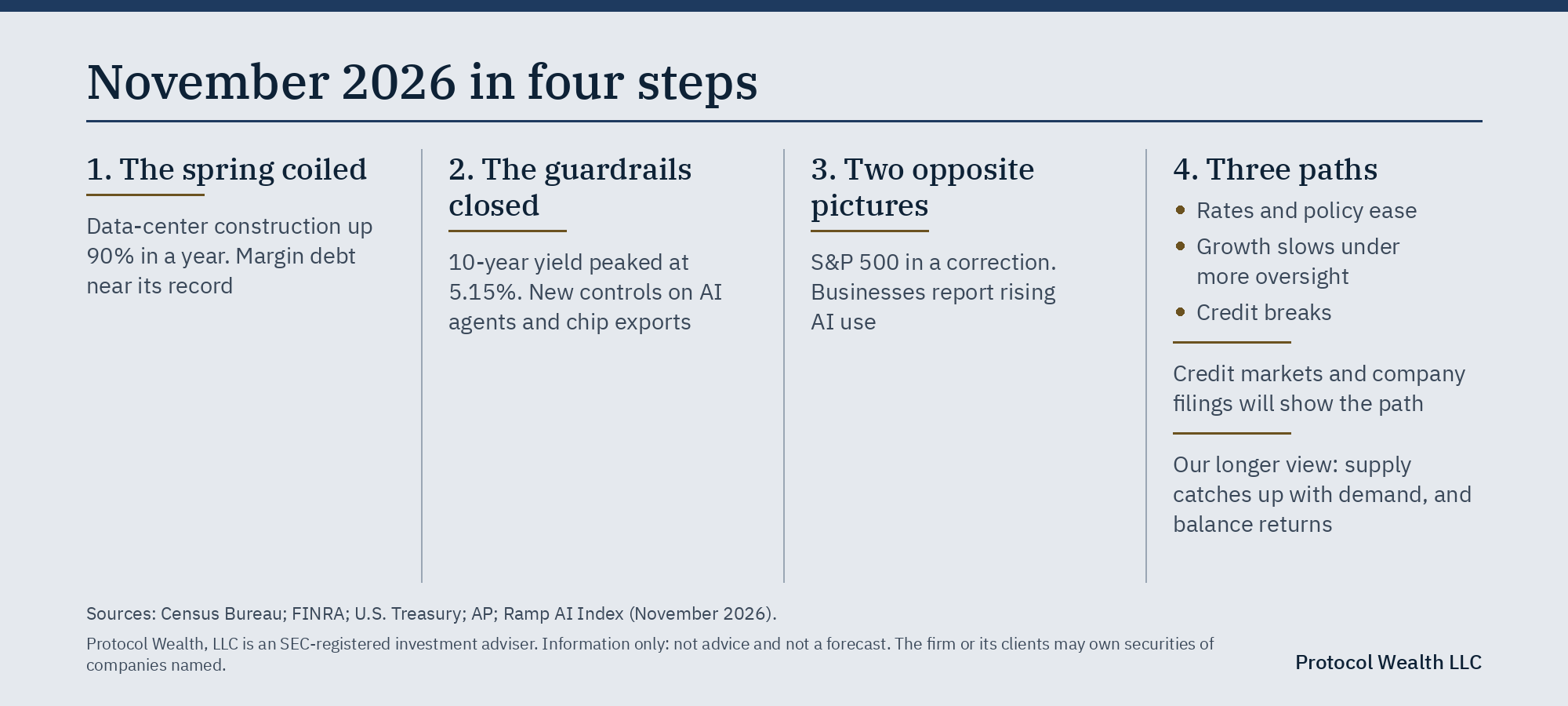
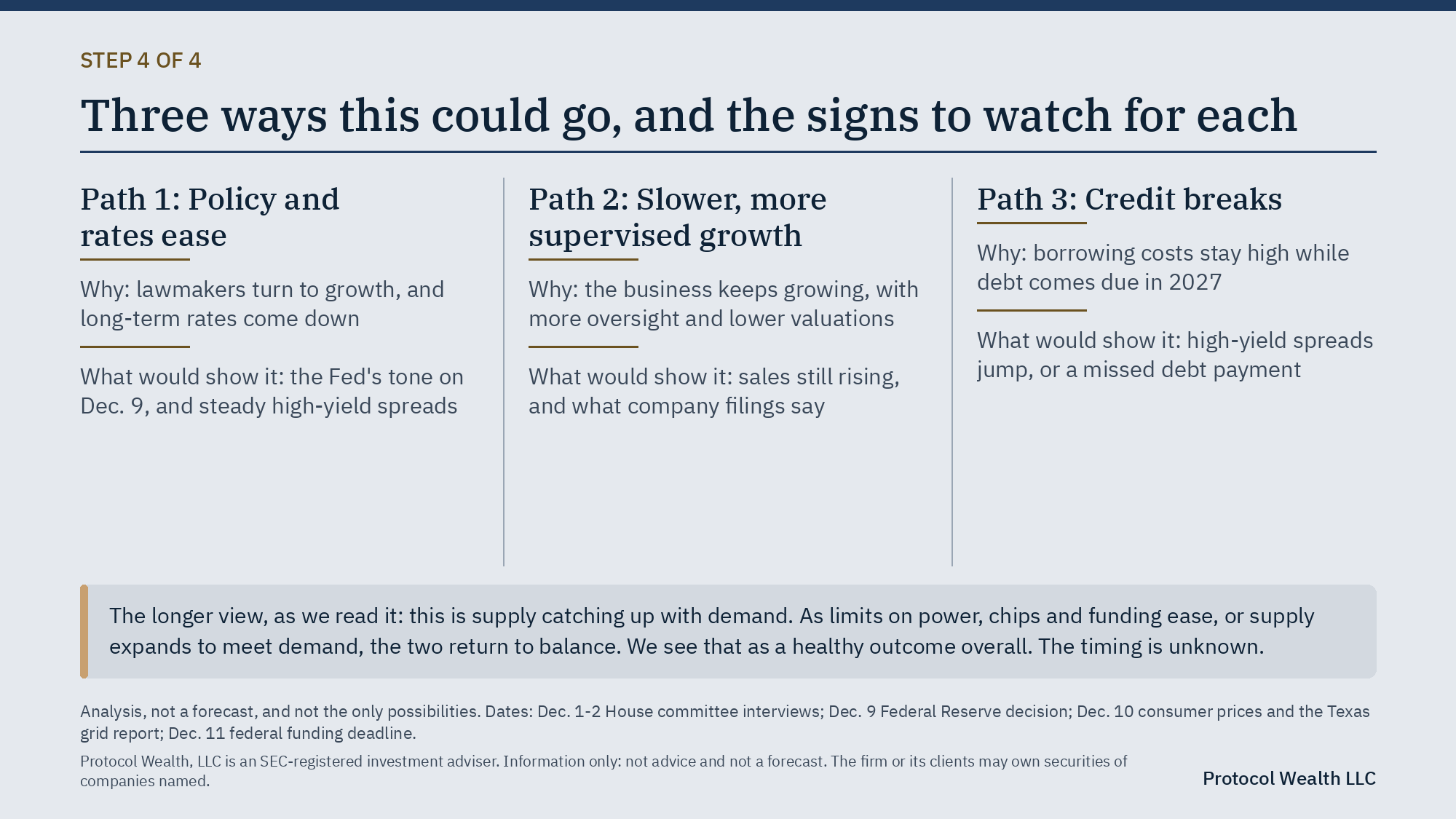
These are three ways the next few months could go. They are analysis, not forecasts, and they are not the only possibilities.
- Policy and rates ease. Lawmakers turn to growth and competition, long-term interest rates come down, and prices recover quickly if, as I read it, much of the selling was forced.
- A slower, more supervised industry. The business keeps growing, with more oversight and lower valuations than investors had become used to.
- Credit breaks. Borrowing costs stay high, the companies with the most debt due in 2027 cannot refinance, and the trouble spreads from stock prices to lenders.
To tell them apart, I would look at credit markets before stock prices, and at filings before commentary.
Whichever path comes first, my longer view is that this is supply catching up with demand. If the limits on power, chips and funding ease, or supply expands to meet demand, the two come back into balance. I read that as a healthy outcome overall, though nobody knows how long it takes.
Dates on the calendar, not predictions:
- December 1 and 2: House committees hold closed-door interviews in their Nvidia inquiry, as reported by CNBC.28
- By early December: Nvidia's quarterly report is due; the company has said only that it will file in the coming weeks. The most it could owe under the credit backstops it has given partners was $118 billion at quarter-end. Most of that, $105 billion, is credit support for one energy developer. Another $9.5 billion is credit support for power and systems, and $3.5 billion backs land, power and buildings for newer cloud companies. Nvidia says it has made no payments.10
- December 9: the Federal Reserve announces its decision after a two-day meeting. It held its rate at 3.75% to 4% in October, and the minutes say almost all participants judged that further increases would likely be appropriate under their baseline outlooks.2930
- December 10: November consumer prices are published, and the Texas grid operator is due to publish its report on data centers.30
- December 11: federal government funding runs out unless Congress extends it.30
If you want to talk through what any of this means for your own plan, call or write.
Protocol Wealth, LLC is an SEC-registered investment adviser. Registration does not imply a particular level of skill or training. This article is for information only. It is not investment advice or a recommendation to buy, sell or hold any security, and it does not take account of any person's circumstances. Companies are named to report public events. Protocol Wealth or its clients may own securities of companies named. Scenarios are analysis, not forecasts. All investing involves risk, including the loss of principal. Figures are as reported by the sources below as of November 21, 2026.
- Associated Press via FinChannel, "Nasdaq falls 5.3% as S&P 500 and Dow enter corrections," November 20, 2026, https://finchannel.com/nasdaq-falls-5-3-as-sp-500-and-dow-enter-corrections/142573/american-business-trends/stock-prices/2026/11/; StockTitan, https://www.stocktitan.net/articles/stock-market-today-live-november-20-2026 (index and Nvidia closing figures) ↩
- Cboe Volatility Index, November 20, 2026: high 40.03, close 35.89 (Yahoo Finance historical data), https://finance.yahoo.com/quote/%5EVIX/history/ ↩
- Crypto Briefing, "Bitcoin falls to its lowest level since September 2024," November 20, 2026, https://cryptobriefing.com/bitcoin-falls-lowest-level-since-september-2024/; The National, "Why is gold price going down?", November 20, 2026, https://www.thenationalnews.com/business/money/2026/11/20/why-is-gold-price-going-down/ ↩
- David Marlin (Marlin Capital), "Only 2 other times in 40 years," chart posted on X, November 2026, of Goldman Sachs Global Investment Research data; reproduced by Syz Group, November 20, 2026, https://blog.syzgroup.com/syz-the-moment/over-the-last-40-yrs-there-have-been-only-2-instances-where-the-avg-spx-return-dispersion-was-this-high. Return dispersion there is twice the standard deviation of the trailing three-month returns of the stocks in the S&P 500, averaged by year; the 2026 figure is for the year so far. We have not seen the underlying Goldman Sachs data and found no Goldman Sachs publication of these figures. ↩
- Nvidia press release, third quarter of fiscal 2027, November 17, 2026 (outlook of $130.0 billion, plus or minus 3%, which includes an extra week and assumes no data-center compute revenue from China), https://www.sec.gov/Archives/edgar/data/1045810/000104581026000088/q3fy27pr.htm ↩
- Ramp AI Index: token volume up 27.2% between the week ending October 18 and the week ending November 15, 2026, among companies using Ramp's token-spend product; token spending rose 12.0%, https://ramp.com/data/ai-index ↩
- S&P Global Ratings, "AI Infrastructure Investment To Exceed $1.3 Trillion By 2027," August 27, 2026 (a forecast), https://press.spglobal.com/2026-08-27-AI-Infrastructure-Investment-To-Exceed-1-3-Trillion-By-2027,-S-P-Global-Ratings-Says ↩
- U.S. Department of the Treasury, daily par yield curve rates, November 2026, https://home.treasury.gov/resource-center/data-chart-center/interest-rates/TextView?type=daily_treasury_yield_curve&field_tdr_date_value_month=202611 ↩
- Nvidia press release filed with the SEC, November 12, 2026, https://www.sec.gov/Archives/edgar/data/0001045810/000104581026000082/nvidiaannouncesceotransiti.htm ↩
- Nvidia chief financial officer commentary, third quarter of fiscal 2027, November 17, 2026 (maximum gross exposure; Nvidia states no payments have been made), https://www.sec.gov/Archives/edgar/data/0001045810/000104581026000088/q3fy27cfocommentary.htm ↩
- FINRA margin statistics: debit balances of $1,448 billion in October 2026 and $1,502 billion in June 2026, https://www.finra.org/rules-guidance/key-topics/margin-accounts/margin-statistics ↩
- Nvidia blog, January 21, 2026, https://blogs.nvidia.com/blog/davos-wef-blackrock-ceo-larry-fink-jensen-huang/ ↩
- Jensen Huang, "AI Is a 5-Layer Cake," Nvidia blog, March 10, 2026, https://blogs.nvidia.com/blog/ai-5-layer-cake/ ↩
- Reuters, "Nvidia building 1-trillion-parameter Nemotron 4 to rival open AI models," August 11, 2026, https://www.bnnbloomberg.ca/business/company-news/2026/08/11/nvidia-building-1-trillion-parameter-nemotron-4-to-rival-open-ai-models/ ↩
- Nvidia, Nemotron 3 Ultra model card (550 billion parameters, open weights), June 4, 2026, https://huggingface.co/nvidia/NVIDIA-Nemotron-3-Ultra-550B-A55B-BF16; modified versions with refusals removed are published by third parties. ↩
- Matt Zeigler, "K, OK," Panoptica, November 18, 2026, https://www.panoptica.com/k-ok/; Peter Atwater, "The Backlash Parallels in Business and Global Politics," Panoptica, November 17, 2026, https://www.panoptica.com/the-backlash-parallels-in-business-and-global-politics/ ↩
- Jared Blikre, Yahoo Finance, November 3, 2026, calculated from Federal Reserve data, https://finance.yahoo.com/economy/article/the-economy-is-less-k-shaped-than-you-think--and-thats-bad-news-for-the-fed-110000449.html ↩
- American Council for an Energy-Efficient Economy, May 13, 2024 (17.8% of income on home energy and auto fuel, from the Consumer Expenditure Survey), https://www.aceee.org/blog-post/2024/05/low-income-households-spend-nearly-20-income-home-energy-and-auto-fuel-costs ↩
- Fortune, November 13, 2026, https://fortune.com/2026/11/13/voters-data-centers-ballot-measures-midterms/ ↩
- OpenRouter, "Open-weight vs. closed-weight models," October 31, 2026 (71.7% of tokens among its top 50 models in the week of September 28, 2026; one platform, not the whole market), https://openrouter.ai/blog/insights/open-weight-vs-closed-weight-models/ ↩
- FBI FLASH-20261113-001, November 13, 2026, https://www.ic3.gov/csa/2026/261113.pdf ↩
- CrowdStrike press release, November 3, 2026, https://www.crowdstrike.com/en-us/press-releases/crowdstrike-introduces-ai-kill-switch-for-ai-safety/ ↩
- Bureau of Industry and Security, "Addressing Remote Access to Advanced Semiconductors," released November 16, 2026, 91 FR 74970, https://www.govinfo.gov/content/pkg/FR-2026-11-19/pdf/2026-23529.pdf ↩
- Nvidia, "NVIDIA Board of Directors Establishes National Security and Export Control Oversight Committee," November 17, 2026, https://nvidianews.nvidia.com/news/nvidia-board-of-directors-establishes-national-security-and-export-control-oversight-committee ↩
- Bloomberg News, November 20, 2026, as reported by Briefs (KKR and EdgeCore), https://www.briefs.co/news/kkr-s-helix-in-talks-to-buy-control-of-edgecore-at-up-to-10/, and by Yahoo Finance (CrowdStrike and Zscaler), https://finance.yahoo.com/markets/stocks/articles/zs-stock-soars-hours-while-221602439.html ↩
- Brent Donnelly, "Spooky Backtests for Halloween," Panoptica, October 27, 2026, https://www.panoptica.com/spooky-backtests-for-halloween/ ↩
- Military Times, "Naval Academy reinstates celestial navigation," November 1, 2015, https://www.militarytimes.com/news/your-military/2015/11/01/naval-academy-reinstates-celestial-navigation/ ↩
- CNBC, November 17, 2026, https://www.cnbc.com/2026/11/17/nvidia-jensen-huang-house-committee.html ↩
- Federal Reserve, minutes of the Federal Open Market Committee, October 27-28, 2026, https://www.federalreserve.gov/monetarypolicy/fomcminutes20261028.htm ↩
- Federal Reserve meeting calendar, https://www.federalreserve.gov/monetarypolicy/fomccalendars.htm; Bureau of Labor Statistics release schedule, https://www.bls.gov/schedule/news_release/cpi.htm; ERCOT, https://www.ercot.com/about/legal/data-center-impact-rfi; continuing resolution through December 11, 2026 (P.L. 119-103). ↩