
·10 min read
Steel doors, weak latches: 2FA hype, automated agents, and the security steps that actually work
Did AI agents really get past two-factor authentication in 14 minutes? What the reports say, what the math says, and four habits that protect your accounts.
By Nick Rygiel, CFP® · Co-Founder and Chief Technology Officer
Artificial intelligence has not broken the math behind your login codes. The exposure is in the things around the math: login habits, software that was set up carelessly, and patches written in a hurry. Families and business owners can plan around all three.
In August 2006 the government of Bahrain blocked Google Earth for about three days. In the weeks that followed, activists passed around annotated satellite images showing how much land the ruling family held.1 The lesson has aged well: once an everyday tool lets anyone look over the wall, keeping things out of sight stops working as a defense.
Cybersecurity is going through a similar change this autumn, and the television coverage of it can push people toward the wrong conclusion.
Most people picture account security as a heavy steel vault door. For the cryptography itself, that picture is right: the door is intact. What holds most accounts shut day to day is closer to a piece of string: a text-message code, a browser that is still logged in, a plug-in from a company you have never heard of, and a busy person who trusts a familiar face on a Tuesday afternoon.
What the "14 minutes" story does and does not say
Two stories ran within days of each other. First, on November 17, reports citing six people familiar with the matter said the National Security Agency's classified internal network had gone down. The agency described it as a temporary degradation during scheduled maintenance, and officials said it was not a cyberattack.2
Then, in a CNN interview, David Kennedy, a former NSA hacker who founded the security firm TrustedSec, described an attack on one of his firm's clients. In his account, more than 30 different types of AI agents probed the company at once. The attackers already held valid usernames and passwords, found a flaw in how the company's own application handled its two-factor step, took data, and encrypted the file system. "This all took 14 minutes," he said. His account has not been independently verified, it has been publicly questioned, and the client was not named.3
Read closely, that account is not about broken codes. The attackers logged in with real passwords and walked through a mistake in one company's software. That is the pattern worth understanding.
| What automated tools cannot do | How accounts are actually taken over |
|---|---|
| Compute an authenticator code without the secret key stored in your app | A fake login page relays your code to the real site within seconds |
| Guess a six-digit code that changes every 30 seconds when the site limits attempts | A flaw in a company's own login software skips the second step |
| Use a hardware security key on a look-alike website | A stolen browser session is reused after you have already logged in |
- The codes hold. An authenticator app combines a secret key with the current time to produce a six-digit code, usually every 30 seconds.4 Without the key, nobody can calculate the code, and a site that limits wrong attempts leaves no time to guess one in a million.
- Attackers go around. A code you type into a convincing fake page can be passed to the real site while it is still valid, and the attacker keeps the logged-in session that results.5 Hardware security keys and passkeys close that route, because they answer only to the website they were registered with.6
A second number in the news needs the same care. Public vulnerability records passed 100,000 for the year in mid-November, and October's count was about four times that of October 2025.7 Most of those records never touch a small business. Weak logins and misplaced trust do.
Three different things happened this month
Not every disruption in the past two weeks was an attack, and treating them as one event causes needless alarm.
- Ordinary failures and own-goals. The Federal Aviation Administration stopped departures nationwide for about four hours on November 13 and attributed it to a temporary telecommunications outage; officials said it did not appear to be a cyberattack, and the cause had not been established at the time.8 The writer Derek Thompson compared some recent corporate outages to a soccer team scoring on its own goal: engineers rushing out fixes for newly found flaws and breaking their own systems.9 Real incidents continue as well. The U.S. Department of Agriculture took several systems offline during the week of November 16 after a security incident.10
- Automated tools chaining small weaknesses. On November 13 the FBI described ARTEX, an open-source framework driven by an AI model. In some intrusions it reached privileged access in under three hours, and the FBI reported attempted sign-ins to more than 2,250 organizations downstream of a compromised cloud-backup service, along with data theft at South Korean financial institutions.11 Google's threat researchers reported on November 16 that another autonomous framework had been used in intrusions, including against U.S. aerospace targets.12 On November 17, attackers published two versions of a Microsoft software package for building AI agents with credential-stealing code inside.13
- Old-fashioned deception, now with video. On November 12 the FBI warned about a North Korean scheme it calls "FaceStealer", which has taken more than $400 million in 18 months. Targets are invited to what looks like a Zoom, Teams or Google Meet call on a look-alike web address, see secretly recorded video of someone they know, and are then asked to install a "fix" for an audio problem.14 That is separate from the theft of more than $6 billion from the exchange Binance on October 29, which the FBI attributed to another North Korean group; U.S. authorities and private companies have since frozen more than $2.7 billion.15
State-backed groups are not the only concern. Some of the most damaging break-ins of recent years were carried out by teenagers and young adults who talked their way past help desks and hijacked phone numbers.16 Large AI models can now be downloaded, stripped of their safety limits, and run on rented computers.17
The same month brought a run of new controls. CrowdStrike added a manual "kill switch" for AI agents on November 3. The Commerce Department released a rule on November 16 restricting exports to overseas data centers that supply remote computing power to certain foreign companies. Nvidia's board set up a national security and export control oversight committee on November 17.18
Four habits that close the side door
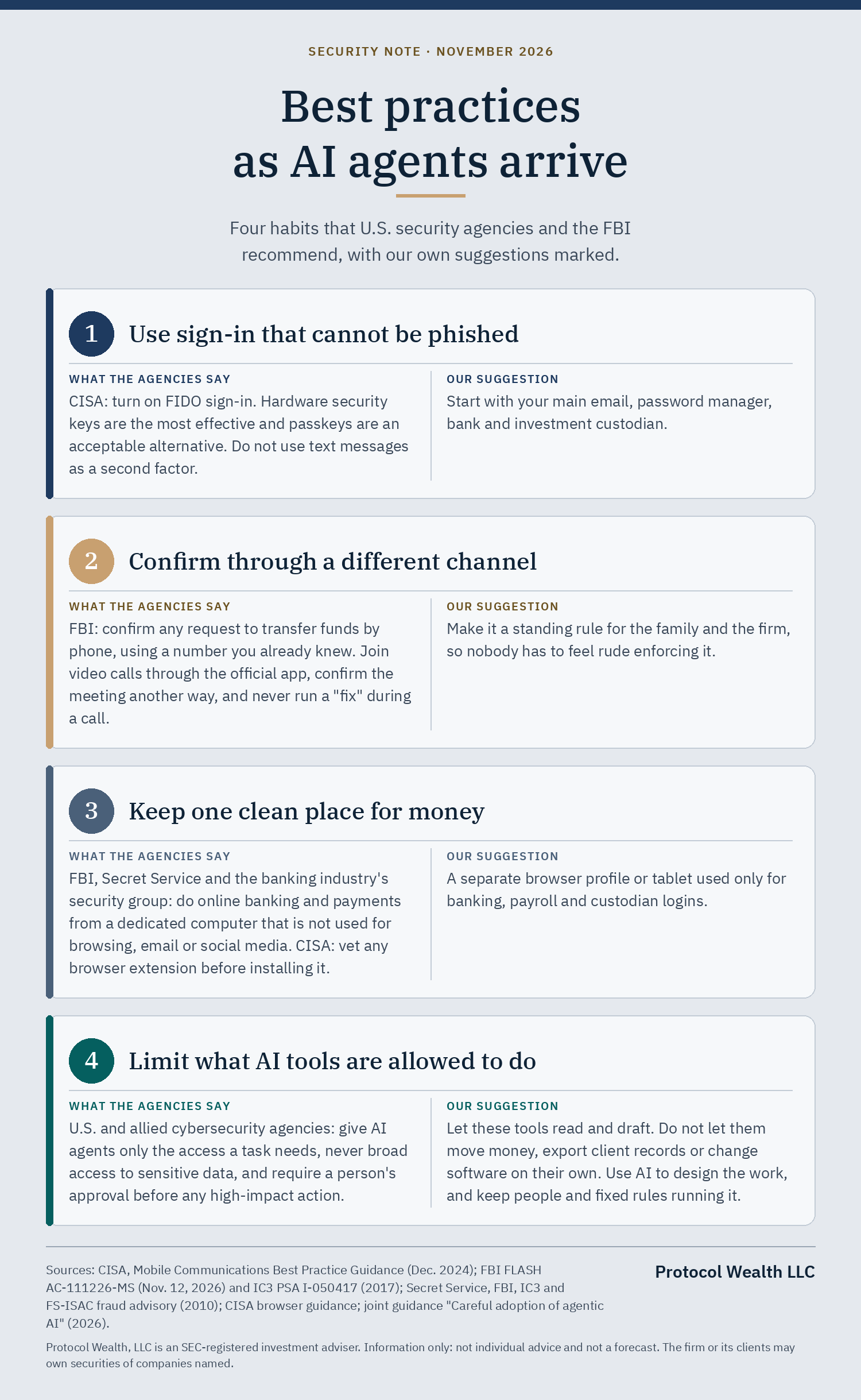
Thanksgiving week is a good time to tighten up at home and at the office. The core of each is what the FBI or a government security agency already recommends. Where we add a suggestion of our own, we say so.
- Use sign-in that cannot be phished on the accounts that matter most. The U.S. cybersecurity agency, CISA, tells people at high risk to turn on FIDO authentication, calls hardware security keys the most effective form and passkeys an acceptable alternative, and says plainly: "Do not use SMS as a second factor for authentication." It adds that authenticator codes are better than text messages but can still be phished.19 Our suggestion: start with your main email, password manager, bank and investment custodian.
- Confirm through a different channel before you act. For video calls, the FBI's November 12 alert says to join through the official app with the invite code and not a link, to confirm the meeting with the person by a different route from the one the invitation came by, and never to run a script or paste code to "update" during a call.14 For money, the FBI's long-standing advice on payment fraud is to confirm any request to transfer funds by phone, using a number you already knew and not one supplied in the request.20
- Keep one clean place for money. The FBI, the Secret Service and the banking industry's security group advised businesses in 2010 to do online banking and payments from a dedicated computer that is not used for general browsing, email or social media.21 The FBI also warns that criminals steal the "cookies" that keep you logged in, which lets them in without your second factor, and CISA advises vetting any browser extension before installing it.22
- Limit what AI tools are allowed to do. U.S. and allied cybersecurity agencies advise giving AI agents only the minimum access a task requires, never broad access to sensitive data or critical systems, and requiring a person's approval before any high-impact action.23 Our suggestion: let these tools read and draft, and do not let them move money, export client records or change software on their own.
We covered the basics of account protection in Protecting your financial accounts online: what actually matters. If you have questions about any of this, ask us.
Two companion notes: the market side of this month is in Among the widest in 40 years, and how to put these tools to work is in Technology and the hard reset.
Protocol Wealth, LLC is an SEC-registered investment adviser. Registration does not imply a particular level of skill or training. This article is for education and information only. It is not investment, legal, tax or cybersecurity advice, and it is not a recommendation to buy, sell or hold any security. Companies are named to report public events, not to recommend their products or securities. Facts are as reported by the sources below as of November 21, 2026 and may change as investigations continue.
- Global Voices, August 7, 2006; Ethan Zuckerman, "Mapping land distribution in Bahrain," October 31, 2006, https://ethanzuckerman.com/2006/10/31/mapping-land-distribution-in-bahrain/ ↩
- Nextgov, "Classified NSA communications network down, people familiar say," November 2026, https://www.nextgov.com/digital-government/2026/11/classified-nsa-communications-network-down-people-familiar-say/417277/ ↩
- CNN, Erin Burnett OutFront, interview with David Kennedy, November 19, 2026; reported in International Business Times UK, https://www.ibtimes.co.uk/ai-attack-bypassed-two-factor-authentication-14-minutes-1833605 ↩
- Internet Engineering Task Force, RFC 6238, "TOTP: Time-Based One-Time Password Algorithm," https://www.rfc-editor.org/rfc/rfc6238 ↩
- Paul Walsh, "The Insecure Elephant in the Room," PKI Consortium, October 10, 2019, https://pkic.org/2019/10/10/the-insecure-elephant-in-the-room/; on session capture, Kuba Gretzky, Evilginx, https://github.com/kgretzky/evilginx2 ↩
- FIDO Alliance, "How passkeys work," https://www.passkeycentral.org/introduction-to-passkeys/how-passkeys-work ↩
- Black Kite, "100K CVE Report 2026" (National Vulnerability Database data: 17,051 records in October 2026 against 4,273 in October 2025; 100,000 reached in 322 days), https://blackkite.com/reports/100k-cve-report-2026 ↩
- CNBC, "FAA ground stop," November 13, 2026, https://www.cnbc.com/2026/11/13/faa-ground-stop.html ↩
- Derek Thompson, "Why Everything Is Suddenly Breaking All at Once," November 19, 2026, https://www.derekthompson.org/p/why-everything-is-suddenly-breaking ↩
- Nextgov, "USDA grapples with security breach as IT staff take multiple systems offline," November 19, 2026, https://www.nextgov.com/cybersecurity/2026/11/usda-grapples-security-breach-it-staff-take-multiple-systems-offline/417350/ ↩
- FBI FLASH-20261113-001, "Threat Overview of ARTEX Autonomous Penetration Testing Framework," November 13, 2026, https://www.ic3.gov/csa/2026/261113.pdf ↩
- Google Threat Intelligence Group, "Agentic threat activity crosses a significant threshold," November 16, 2026, https://cloud.google.com/blog/topics/threat-intelligence/agentic-threat-activity-crosses-a-significant-threshold ↩
- GitHub Advisory GHSA-764m-3ppc-5m73, "Malicious code in agent-framework (PyPI)," November 18, 2026, https://github.com/advisories/GHSA-764m-3ppc-5m73 ↩
- FBI FLASH AC-111226-MS, "North Korean Hackers Use Secretly Recorded Webcam Library of 900+ Tech Workers in $400M 'FaceStealer' Crypto Theft Scheme," November 12, 2026, https://www.ic3.gov/CSA/2026/261112.pdf ↩
- CoinDesk, "North Korea's Binance hack faces U.S. crackdown as DOJ targets $1.2 billion in stolen crypto," November 12, 2026, https://www.coindesk.com/policy/2026/11/12/north-korea-s-binance-hack-faces-u-s-crackdown-as-doj-targets-usd1-2-billion-in-stolen-crypto ↩
- KrebsOnSecurity, "A Closer Look at the LAPSUS$ Data Extortion Group," March 23, 2022, https://krebsonsecurity.com/2022/03/a-closer-look-at-the-lapsus-data-extortion-group/ ↩
- Nvidia, Nemotron 3 Ultra model card (550 billion parameters, open weights), June 4, 2026, https://huggingface.co/nvidia/NVIDIA-Nemotron-3-Ultra-550B-A55B-BF16; modified versions with refusals removed are published by third parties. ↩
- CrowdStrike press release, November 3, 2026, https://www.crowdstrike.com/en-us/press-releases/crowdstrike-introduces-ai-kill-switch-for-ai-safety/; Bureau of Industry and Security, "Addressing Remote Access to Advanced Semiconductors," 91 FR 74970, https://www.govinfo.gov/content/pkg/FR-2026-11-19/pdf/2026-23529.pdf; Nvidia board announcement, November 17, 2026, https://nvidianews.nvidia.com/news/nvidia-board-of-directors-establishes-national-security-and-export-control-oversight-committee ↩
- Cybersecurity and Infrastructure Security Agency, "Mobile Communications Best Practice Guidance," December 18, 2024 (written for highly targeted individuals; described as applicable to all audiences), https://www.cisa.gov/sites/default/files/2024-12/guidance-mobile-communications-best-practices.pdf ↩
- FBI Internet Crime Complaint Center, public service announcement I-050417-PSA on business email compromise, May 4, 2017, https://www.ic3.gov/PSA/2017/PSA170504 ↩
- U.S. Secret Service, FBI, Internet Crime Complaint Center and FS-ISAC, "Fraud Advisory for Businesses: Corporate Account Take Over," October 2010, https://www.ic3.gov/PSA/2010/CorporateAccountTakeOver.pdf ↩
- FBI Atlanta, "Cybercriminals Are Stealing Cookies to Bypass Multifactor Authentication," October 30, 2024, https://www.fbi.gov/contact-us/field-offices/atlanta/news/cybercriminals-are-stealing-cookies-to-bypass-multifactor-authentication; CISA, "Tips to Stay Safe while Surfing the Web, Part 1," https://www.cisa.gov/resources-tools/training/tips-stay-safe-while-surfing-web-part-1-web-browser-settings ↩
- Canadian Centre for Cyber Security with CISA, the NSA and the cybersecurity agencies of Australia, New Zealand and the United Kingdom, "Careful adoption of agentic AI," 2026, https://www.cyber.gc.ca/en/guidance/careful-adoption-agentic-ai ↩